
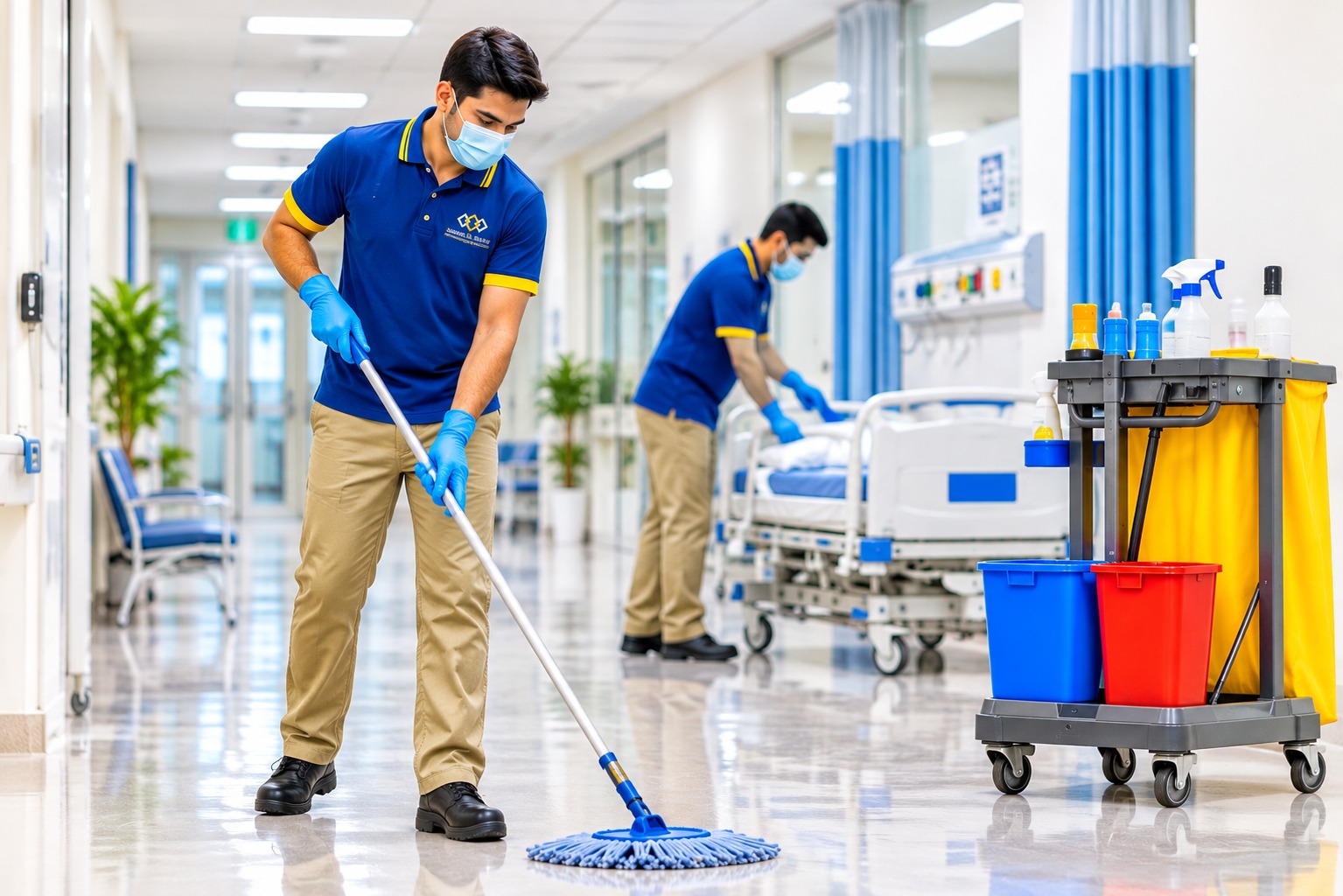
Executive Summary
Hospital cleaning services in Saudi Arabia follow strict infection-control protocols set by the Ministry of Health and international bodies like the Saudi Central Board for Accreditation of Healthcare Institutions (CBAHI).
A compliant healthcare cleaning company uses zone-based cleaning, hospital-grade disinfectants, and trained staff to reduce hospital-acquired infections (HAIs), which the World Health Organization links to longer patient stays and higher treatment costs (WHO).
This guide breaks down what hospital cleaning standards actually require, how ICU and operating theatre cleaning differ from general housekeeping, and how to choose a medical facility cleaning partner in Riyadh, Jeddah, or anywhere in the Kingdom.
What Is Hospital Cleaning?
Hospital cleaning is a specialized form of clinical cleaning service designed to eliminate pathogens, not just visible dirt.
Unlike standard commercial cleaning, hospital housekeeping services follow risk-zoning protocols:
- Low-risk areas: Waiting rooms, offices, and administrative spaces
- Moderate-risk areas: General wards and patient rooms
- High-risk areas: ICUs, operating theatres, and isolation rooms
Each zone requires different cleaning protocols, frequencies, and chemical grades.
Hospital cleaning should be considered a clinical function, not just a janitorial service. Staff typically require training in:
- Bloodborne pathogen handling
- Infection-control procedures
- Color-coded equipment systems to prevent cross-contamination
- Correct disinfectant dwell times to ensure pathogens are eliminated
Why Do Hospital Cleaning Standards Matter?
Poor cleaning protocols directly contribute to hospital-acquired infections.
The WHO estimates that in developed countries, 7 out of every 100 hospitalized patients acquire at least one healthcare-associated infection (HAI) during their stay, with higher rates reported in some lower- and middle-income settings.
In Saudi Arabia, CBAHI accreditation standards require documented infection-prevention measures and environmental cleaning protocols as part of healthcare facility compliance.
Key Takeaway
A hospital cleaning contractor is not simply a cosmetic service provider — it is an essential part of the infection-control chain.
Healthcare facilities outsourcing cleaning services need a partner that understands accreditation requirements, infection prevention, and clinical cleaning standards, not just routine housekeeping schedules.
How Does ICU Cleaning Differ From General Ward Cleaning?
ICU cleaning services require stricter procedures and higher cleaning frequency because ICU patients are critically vulnerable and often immunocompromised.
- Terminal Cleaning After Every Patient Discharge
Why it matters:
Prevents pathogen transmission to the next patient, especially multidrug-resistant organisms (MDROs).
- Frequent High-Touch Surface Disinfection
Examples include:
- Bed rails
- Patient monitors
- IV poles
- Medical equipment surfaces
Why it matters:
ICU equipment is touched frequently by healthcare workers, increasing contamination risks.
- Use of Hospital-Grade Disinfectants
Approved disinfectants should have documented effectiveness against pathogens such as:
- MRSA
- C. difficile
- Other healthcare-associated organisms
Why it matters:
General-purpose cleaners may not meet healthcare infection-control requirements.
- Dedicated Color-Coded Cleaning Equipment
Why it matters:
Prevents cross-contamination between different hospital zones.
- Documented Cleaning Logs
Cleaning records should include:
- Date and time stamps
- Staff verification
- Completed cleaning procedures
Why it matters:
Required for CBAHI audits and internal quality inspections.
How Does Operating Theatre Cleaning Work?
Operating theatre cleaning follows a stricter process than general ward cleaning because surgical environments require extremely controlled hygiene conditions.
- Pre-Operative Cleaning
Surfaces and equipment are disinfected before the first surgical procedure of the day.
- Between-Case Cleaning
A rapid but thorough cleaning process is performed between surgeries, including:
- Operating tables
- Surgical lights
- High-touch surfaces
- Terminal (End-of-Day) Cleaning
A complete deep cleaning process covering:
- Floors
- Walls
- Ventilation areas
- Fixed medical equipment
- Scheduled Deep Cleaning
Weekly or monthly intensive cleaning may include:
- Advanced decontamination procedures
- Fogging
- UV-C disinfection in high-risk theatres
Each stage requires specific chemicals, procedures, and completion times. Therefore, operating theatre cleaning contracts are usually managed separately from general hospital housekeeping.
Hospital Cleaning vs. General Commercial Cleaning: What’s the Difference?
| Criteria | Hospital Cleaning | General Commercial Cleaning |
| Staff Training | Bloodborne pathogen and infection-control certification required | Basic janitorial training |
| Chemicals Used | Hospital-grade, SFDA/EPA-registered disinfectants with documented kill claims | General-purpose cleaners and disinfectants |
| Cleaning Frequency | Zone-based cleaning; high-risk areas cleaned multiple times per shift | Usually once daily or according to contract schedule |
| Documentation | Cleaning logs required for accreditation audits | Rarely mandatory |
| Equipment | Color-coded, zone-specific tools | Shared cleaning equipment |
| Compliance Requirements | CBAHI, Ministry of Health, and infection-control standards | Client requirements and general hygiene standards |
How to Choose a Healthcare Cleaning Company in Saudi Arabia
1. Verify Infection-Control Training
Confirm that cleaning staff are trained in:
- Bloodborne pathogen handling
- Infection-control procedures
- Zone-based cleaning methods
Why it matters:
Untrained workers can become a source of cross-contamination.
2. Confirm Chemical Registration
Ensure disinfectants are:
- Registered with the Saudi Food and Drug Authority (SFDA)
- Supported by documented effectiveness claims
Why it matters:
Unverified chemicals may not meet healthcare disinfection standards.
3. Check CBAHI Experience
Choose a provider familiar with:
- CBAHI documentation
- Accreditation preparation
- Healthcare compliance requirements
Why it matters:
Experienced providers reduce audit preparation challenges.
4. Review Reporting and Audit Trails
Cleaning providers should offer:
- Digital records
- Paper documentation
- Inspection reports
Why it matters:
Accreditation bodies require measurable evidence, not verbal confirmation.
5. Confirm Regional Coverage
Whether you require hospital cleaning services in Riyadh, Jeddah, or other Saudi regions, confirm that the provider can offer:
- Local support teams
- Emergency response
- Scheduled and urgent cleaning services
What Does Hospital Deep Cleaning Include?
Hospital deep cleaning goes beyond regular housekeeping.
It typically includes:
- Full floor disinfection
- Wall and ceiling cleaning
- Air vent cleaning
- Curtain cleaning
- Fixed equipment disinfection
- Terminal room cleaning
- Fogging or UV-C disinfection in selected high-risk areas
Facilities usually schedule deep cleaning:
- Weekly
- Monthly
- Quarterly
The frequency depends on the facility risk category and infection-control requirements.
Important Considerations
This guide provides general information about hospital cleaning standards in Saudi Arabia.
It does not replace:
- Facility-specific CBAHI requirements
- Ministry of Health regulations
- Infection-control committee procedures
Requirements may vary depending on facility type, location, and accreditation status.
Always confirm current requirements with the relevant regulatory bodies before finalizing cleaning contracts or procedures.
Get a CBAHI-Aligned Hospital Cleaning Plan
Sawaed Al Halool provides medical facility cleaning services across Saudi Arabia, including:
- ICU cleaning
- Operating theatre cleaning
- Hospital deep cleaning
- Healthcare facility cleaning solutions
Services are designed around international infection-control standards and local accreditation requirements.
Request a customized quotation to receive a cleaning plan tailored to your facility’s risk zones.
Frequently Asked Questions
What is the difference between hospital cleaning and hospital sterilization?
Cleaning removes visible dirt and reduces microbial contamination on surfaces. Sterilization eliminates all microorganisms and is generally used for surgical instruments rather than routine environmental surfaces.
How often should ICU rooms be cleaned?
High-touch surfaces should be disinfected multiple times per shift, with complete terminal cleaning after every patient discharge.
Do hospital cleaning companies in Saudi Arabia need special licensing?
Healthcare cleaning providers should follow Ministry of Health and CBAHI-aligned protocols and use SFDA-registered disinfectants. Exact requirements depend on the facility type.
What chemicals are used in operating theatre cleaning?
Hospitals use approved-grade disinfectants with documented effectiveness against a wide range of pathogens, applied according to manufacturer instructions.
How much does hospital cleaning cost in Saudi Arabia?
Pricing depends on:
- Facility size
- Risk-zone classification
- Cleaning frequency
- Required services
A customized quotation is required for accurate pricing.
What is a hospital-acquired infection (HAI)?
An HAI is an infection that develops during a hospital stay and was not present or developing when the patient was admitted.
Can one company handle hospital cleaning and facility maintenance?
Yes. Some providers offer integrated facility management services combining healthcare cleaning with maintenance solutions.
What is terminal cleaning?
Terminal cleaning is a complete top-to-bottom disinfection process performed after a patient leaves a room before another patient occupies it.
How do cleaning companies prevent cross-contamination?
They use:
- Color-coded cleaning equipment
- Dedicated tools for specific zones
- Strict movement protocols between risk areas